
Rova Scope 10 Genesis
By Bruce Ackley

When I got the call in 1977 to bring a group to the Third Annual Free Music Festival in the Bay Area I immediately thought: saxophone quartet. Larry, Jon and I had been in regular contact for a couple of years, playing together, performing and talking music. Knowing they were kindred spirits made them obvious choices for the quartet. The initial fourth member and first baritone player, Tony Blase, was the Pete Best[1] of the yet-to-be-named foursome. After 3 months of rigorous rehearsals, he decided to depart from the band to return to school. Right in time, Jon’s friend, Andrew Voigt, returned to the Bay Area after having spent time in Michigan studying with Roscoe Mitchell. He joined up with us and, seeing the pending concert staring us down, we were forced to name the ensemble, defaulting to the acronym R-O-V-A, Rova.
My reasons for forming a saxophone quartet were myriad and based on these attributes: it would be rhythm section-less; acoustic; all winds; portable (possible to move with our instruments); ideal for polyphony, and more. The flexibility of the setup seemed boundless, which our long tenure has shown. Since 1975 I’d been performing with an all-wind ensemble, The Sound Clinic, with saxophonist Lewis Jordan and brass player Georgs Sams. And my first group in Detroit started as a rhythm section-less wind trio. My impulse to play in wind groups probably has its roots in my singing soprano in choir as a kid, switching to baritone when my voice changed.
I was also intrigued and inspired by the mid-1970s recordings of Anthony Braxton’s Composition No. 37 (for saxophone quartet), and of Steve Lacy’s Saxophone Special concert (for quartet plus guitar and electronics). Each recording bore the mark of its leader and exposed individual compositional-improvisational approaches that made the music vivid and dynamic. These seminal works for improvising sax quartet proved to have a lasting impact on Rova, and we have since reprised both the Braxton quartet, and the Lacy concert pieces in performance and on recordings.
In early 1978 we dug in to rehearse at artist Doug Hall’s Pier 40-A studio on San Francisco’s storied Embarcadero. Indicative of the times, our neighbor in the next-door loft was Margo St. James and her organization COYOTE (Call Off Your Old Tired Ethics), San Francisco’s prostitutes’ union. The area was yet to be redeveloped and the City still retained much of the pre-tech vibe that was so favorable to free thinking creative souls still pouring into the Bay Area from more buttoned-down places. It was a perfect setting to begin to establish our identity and to prepare what would unfold into a lifetime of cooperative work.
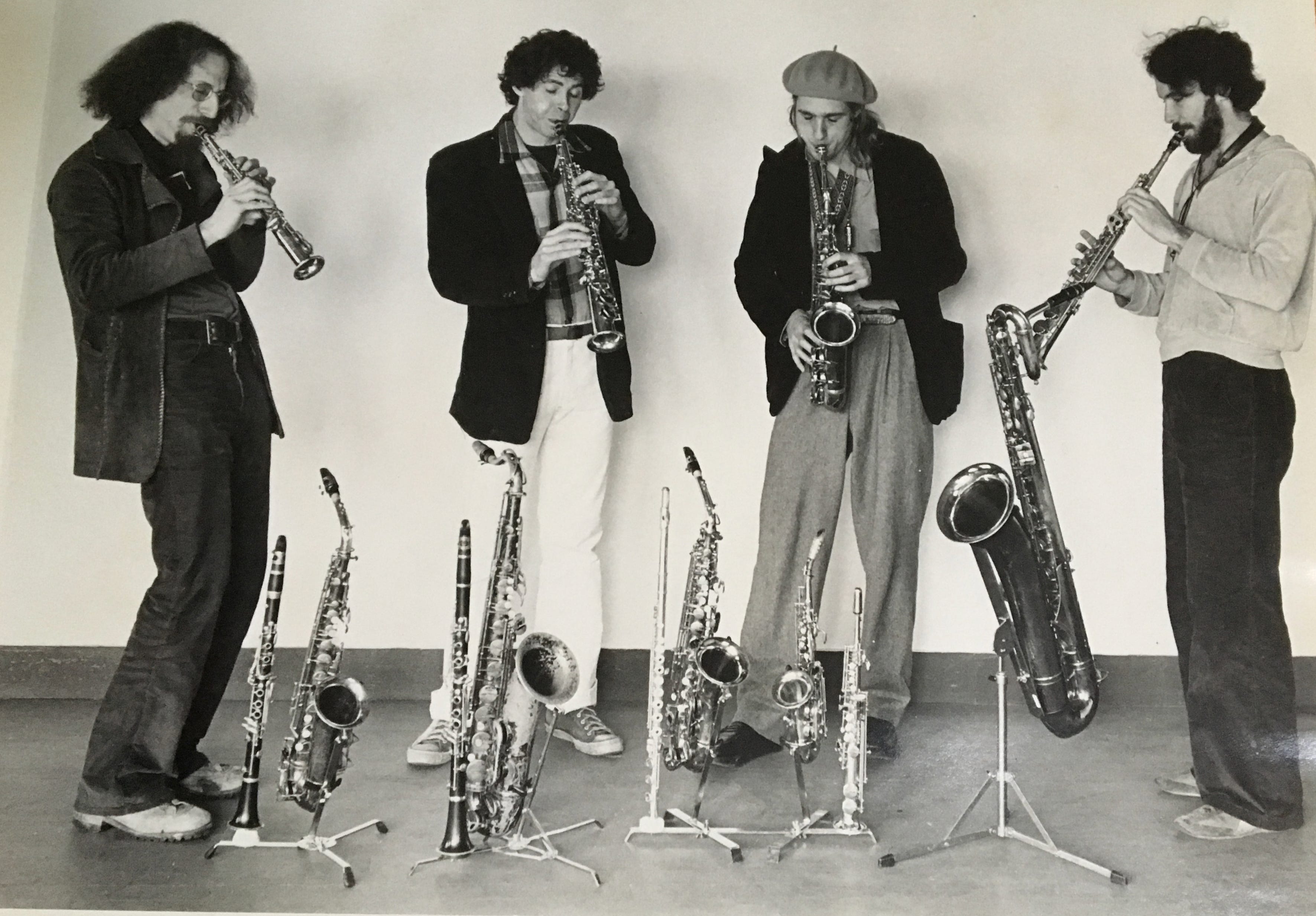
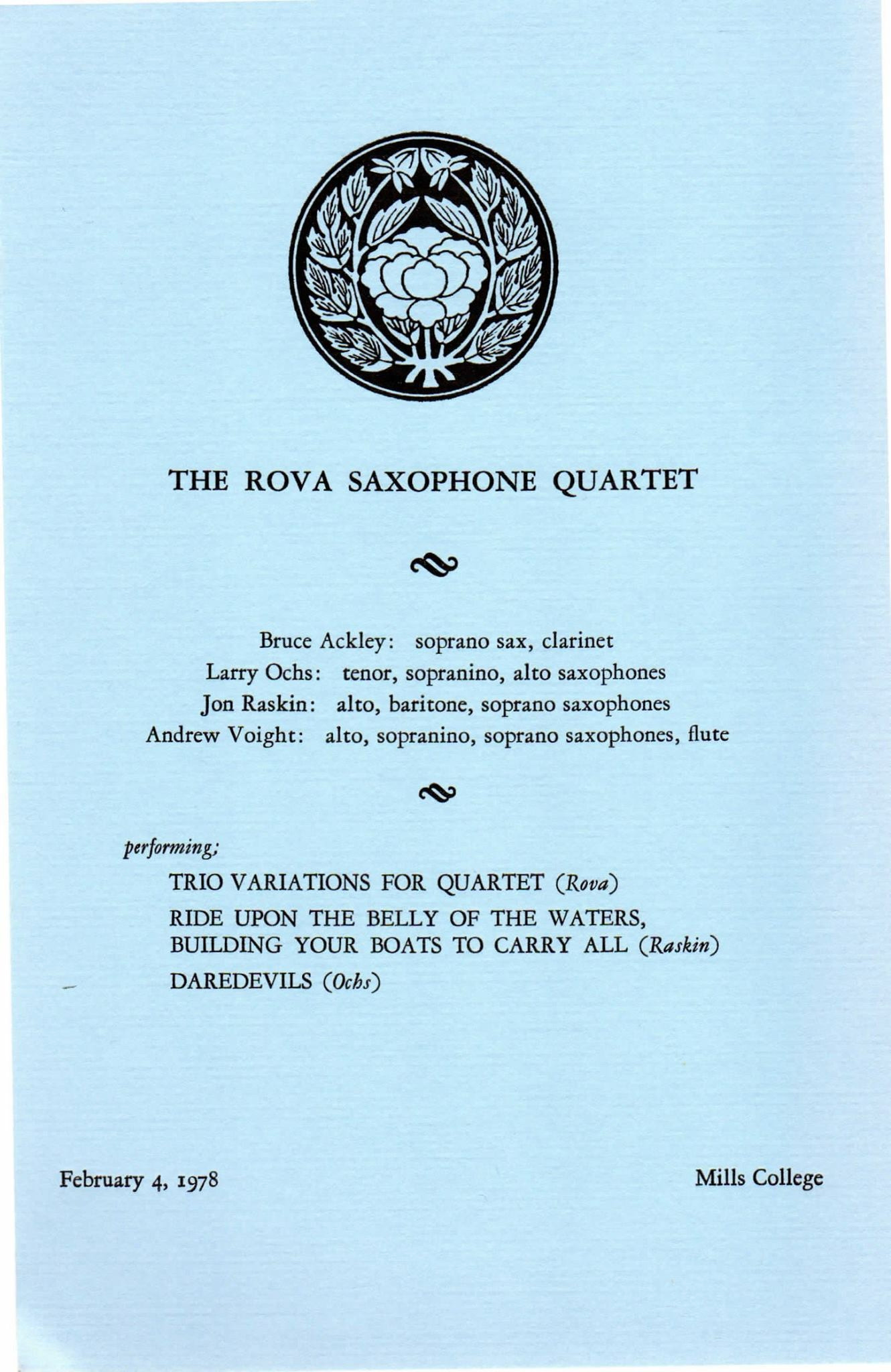
Even though we were still quite rough around the edges, on February 4 we presented our first concert at Mills College in Oakland as part of the Third (and final) Free Music Festival. True to form, we presented compositions by Ochs and Raskin, and a group structured improvisation, a precursor to our Trobar clus[2] series, which opened the Pandora’s box of improvising strategies that would occupy us over the ensuing decades.
Rova’s rehearsal schedule was heavy, the band working together 3 times a week, including a double rehearsal on Sundays (the second half of which was dedicated to free improvisation, our food for thought). We maintained that schedule for over a decade. During those early sessions, we tried whatever we could conjure to make the work that felt authentic to us collectively. There were debates, discussions, heated arguments, lots of laughs, a scary car accident, and some serious getting down to the nitty-gritty. Those Sunday marathons often included family meals prepared by poet/publisher Lyn Hejinian, Larry’s wife. Breaking bread together brought us closer and provided a forum for further discussion about the work and its place in the greater cultural context. In the 1970s Lyn was a driving force behind a new strain of poetics that would later be dubbed ‘language poetry’, and interactions with her and her fellow writers allowed a cross-pollination of ideas that contributed a unique flavor to our work. We discovered we were creating a personal musical language.
What we sought was an original way of blending improvisation and structure to satisfy our newly developing aesthetic. None of us were drawn to solely practicing the religions of non-idiomatic free improvisation, or free jazz. We suspected there was a lot more to explore and to express beyond those 1960’s impulses. We’d been so impacted by Zorn, Lacy, Braxton, Cage, Boulez, Stockhausen, etc. that our ears were yearning to devour the possibilities exposed and sometimes captured during our long hours playing together. Our contact with other colleagues (notably: Chadbourne, Zorn, Kaiser, Greg Goodman, Diamanda Galas, Evan Parker, Derek Bailey, Steve Lacy, LaDonna Smith, Davey Williams, and countless other practitioners) fed us ideas from those wrestling with similar problems to solve.
By the time a year had elapsed since our initial meetings at San Francisco’s Blue Dolphin and Hall’s studio, we’d completed the recording of our first LP, Cinema Rovaté. Soon after, in the fall of 1978, we received an invitation to the following year’s Moers Festival of New Jazz, in what was then West Germany, and a subsequent tour of several European cities. The success of local concerts, the release of the LP, and the coming tour validated our instincts that we had something special happening, inspiring us to keep going.
By 1988, with 10 years in the rear-view, Rova had established a firm foundation becoming more confident in our practice as forward-thinking improviser-composers. Andrew Voigt, through his artistry, dedication and commitment contributed a great deal to our building an identity and voice over that first decade. When he left the band that year we turned to our old pal from Boston, Steve Adams. Steve was already playing in Your Neighborhood Saxophone Quartet (the name a poke at the commonality of sax quartets in the early ‘80s); he was an original and vibrant player, composer and improviser, and he was game. It was our great fortune that we were able to lure him to the west coast to make the quartet whole once again. It helped that we were headed into a lucrative fall tour that included a European premiere of Terry Riley’s Chanting the Light of Foresight, and 5 concerts in quintet with maestro Anthony Braxton. The rest is mystery.
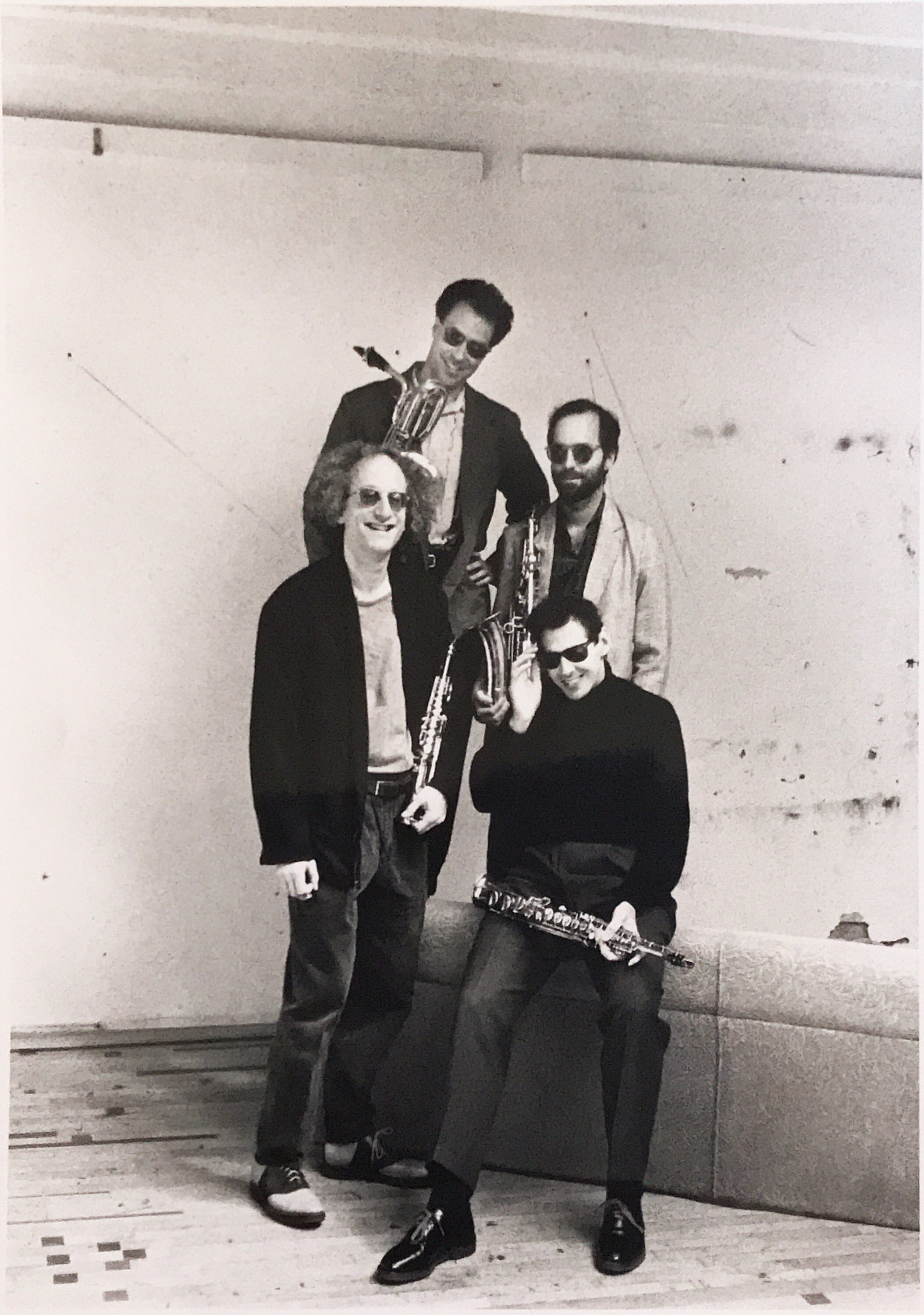
In retrospect I believe my instincts in forming the group were spot on, not just its instrumental makeup, but especially the players. Yet, while those noted attributes of a saxophone quartet have made this a dream ensemble, working in a homogeneous group of like instruments without a rhythm section has been challenging in terms range, time, timbre, volume, blend, intonation and individual expression. It’s the very special mix of Rova’s individual players that has enabled us to channel those challenges into gifts that keeps providing us with ever more to explore.
I’ve offered a bit about our beginnings. There will be an end. In the meantime, we go on because we must.
Bruce Ackley – San Francisco, September 2025
[1] Randolph Peter Best is an English retired musician who was the drummer for the Beatles from 1960 to 1962.
[2] Trobar clus is an Occitan term for a style of medieval Provençal poetry characterized by its complexity, obscurity, and deliberate use of ambiguous language and intricate poetic techniques to create a "closed" and allegorical text intended for a small, discerning audience
I don’t know if you’ll see this, but I just read your story of the origins of your group. While everything ends, please don’t let your quartet end just yet. I’ve seen you play many times, and I don’t feel the story is quite finished. I mean, who else plays butcher paper at a concert? Carry on ROVA!